No Surprise Medical Bill Act & Insurance
AND FAST LOOK UP CRISIS NUMBERS
( OMB control #0938-1401)
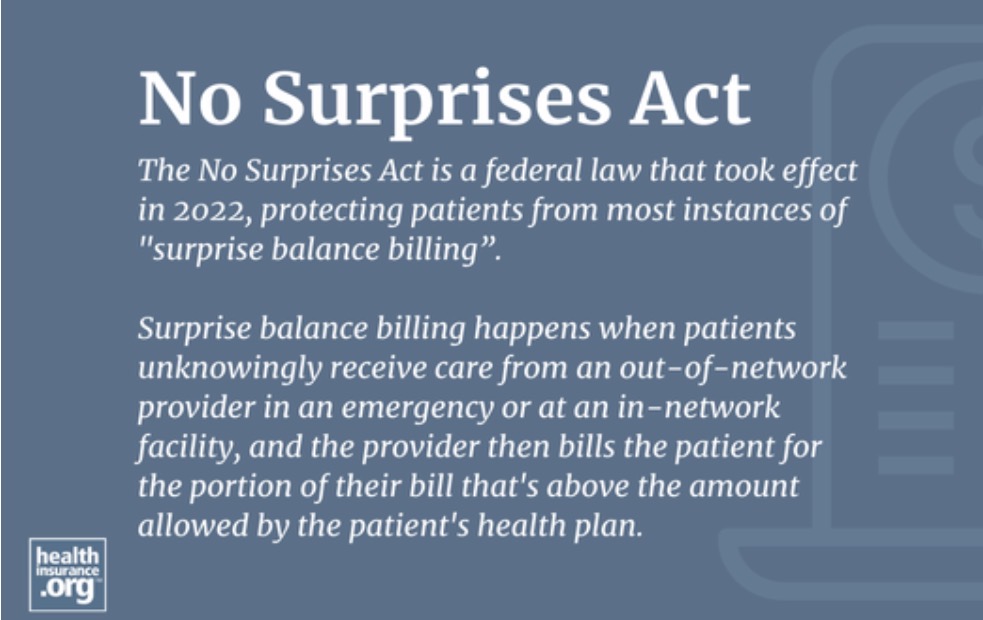
“Surprise billing” is an unexpected or balanced bill. This can happen when you can’t control who is involved in your care.
For example, you have an emergency or you schedule a visit at an in-network facility but are unexpectedly treated by an out-of-network provider ( usually in a healthcare setting).
*Applying this Act at this practice *
-You only pay for what we agree upon… with insurance that will be your copay, or any deductibles we will discuss prior.
The No Surprises Act protects people covered under group and individual health plans from receiving surprise medical bills when they receive most emergency services, non-emergency services from out-of-network providers at in-network facilities, and services from out-of-network air ambulance service providers. It also establishes an independent dispute resolution process for payment disputes between plans and providers, and provides new dispute resolution opportunities for uninsured and self-pay individuals when they receive a medical bill that is substantially greater than the good faith estimate they get from the provider.
Starting in 2022, there are new protections that prevent surprise medical bills. If you have private health insurance, these new protections ban the most common types of surprise bills. If you’re uninsured or you decide not to use your health insurance for a service, under these protections, you can often get a good faith estimate of the cost of your care up front, before your visit. If you disagree with your bill, you may be able to dispute the charges. Here’s what you need to know about your new rights.
What are surprise medical bills?
Before the No Surprises Act, if you had health insurance and received care from an out-of-network provider or an out-of-network facility, even unknowingly, your health plan may not have covered the entire out-of-network cost. This could have left you with higher costs than if you got care from an in-network provider or facility. In addition to any out-of-network cost sharing you might have owed, the out-of-network provider or facility could bill you for the difference between the billed charge and the amount your health plan paid, unless banned by state law. This is called “balance billing.” An unexpected balance bill from an out-of-network provider is also called a surprise medical bill.
People with Medicare and Medicaid already enjoy these protections and are not at risk for surprise billing.
What are the new protections if I have health insurance?
If you get health coverage through your employer, a Health Insurance Marketplace®, or an individual health insurance plan you purchase directly from an insurance company, these new rules will:
- Ban surprise bills for most emergency services, even if you get them out-of-network and without approval beforehand (prior authorization).
- Ban out-of-network cost-sharing (like out-of-network coinsurance or copayments) for most emergency and some non-emergency services. You can’t be charged more than in-network cost-sharing for these services.
- Ban out-of-network charges and balance bills for certain additional services (like anesthesiology or radiology) furnished by out-of-network providers as part of a patient’s visit to an in-network facility.
- Require that health care providers and facilities give you an easy-to-understand notice explaining the applicable billing protections, who to contact if you have concerns that a provider or facility has violated the protections, and that patient consent is required to waive billing protections (i.e., you must receive notice of and consent to being balance billed by an out-of-network provider).
What if I don’t have health insurance or choose to pay for care on my own without using my health insurance (also known as “self-paying”)?
If you don’t have insurance or you self-pay for care, in most cases, these new rules make sure you can get a good faith estimate of how much your care will cost before you receive it.
What if I’m charged more than my good faith estimate?
For services provided in 2022, you can dispute a medical bill if your final charges are at least $400 higher than your good faith estimate and you file your dispute claim within 120 days of the date on your bill.
Where can I learn more?
Still have questions? Visit CMS.gov/nosurprises, or call the Help Desk at 1-800-985-3059 for more information. TTY users can call 1-800-985-3059.
What if I do not have insurance from an employer, a Marketplace, or an individual plan? Do these new protections apply to me?
Some health insurance coverage programs already have protections against surprise medical bills. If you have coverage through Medicare, Medicaid, or TRICARE, or receive care through the Indian Health Services or Veterans Health Administration, you don’t need to worry because you’re already protected against surprise medical bills from providers and facilities that participate in these programs.
What if my state has a surprise billing law?
The No Surprises Act supplements state surprise billing laws; it does not supplant them. The No Surprises Act instead creates a “floor” for consumer protections against surprise bills from out-of-network providers and related higher cost-sharing responsibility for patients. So as a general matter, as long as a state’s surprise billing law provides at least the same level of consumer protections against surprise bills and higher cost-sharing as does the No Surprises Act and its implementing regulations, the state law generally will apply. For example, if your state operates its own patient-provider dispute resolution process that determines appropriate payment rates for self-pay consumers and Health and Human Services (HHS) has determined that the state’s process meets or exceeds the minimum requirements under the federal patient-provider dispute resolution process, then HHS will defer to the state process and would not accept such disputes into the federal process.
As another example, if your state has an All-payer Model Agreement or another state law that determines payment amounts to out-of-network providers and facilities for a service, the All-payer Model Agreement or other state law will generally determine your cost-sharing amount and the out-of-network payment rate.
Where can I learn more?
Still have questions? Visit CMS.gov/nosurprises, or call the Help Desk at 1-800-985-3059 for more information. TTY users can call 1-800-985-3059.
*Counseling Services & Good Faith Estimate & No Surprises Act
If I am not with your insurance or you choose to use private pay…
•A copy of your Good Faith Estimate for Services is offered to you in writing from this office ( our cost per session agreed to prior to service).
•At anytime, if prices as a whole ever change that would be shared and discussed weeks before – Typically an entire month-
•While working together, should you choose to add or change services to include other people or extend session time, those costs will be shared with you ( in writing or verbally ) prior to the next session, or continuing an emergency time extension.
Please contact me with any questions. Contact with Subject line re: Billing
Here are the other important points of this new patient protection act… that apply most to our business
For your knowledge in healthcare settings : What applies most is that we agree to our cost of care and that this is what you will be billed
As a patient, you are now (2026) protected from balanced billing for: Emergency services …
If you have an emergency medical condition and get emergency services from an out-of-network provider or facility, the most the provider or facility may bill you is your plan’s in-network cost-sharing amount (such as copayments and coinsurance).
You can’t be balance billed for these emergency services- in an emergency – your insurance can be billed for extra time under a valid CPT code.
This includes services you may get after you’re in stable condition, unless you give written consent and give up your protections not to be balanced billed for these post-stabilization services.
When balance billing isn’t allowed, you also have the following protections:
• You are responsible for paying your share of the cost (copayments, coinsurance, and deductibles such that you’d pay in-network).
- Now, your health insurance will pay out-of-network providers and facilities.
- This applies in other settings- Your health plan must:
- •Cover emergency services by out-of-network providers
- •Cover emergency services without requiring you to get approval for services in advance (prior authorization).
If you believe that you’ve been billed, inaccurately, please contact: www.cms.gov/nosurprises
Visit https://www.cms.gov/files/document/model-disclosure-notice-patient-protections-against-surprise-billing-providers-facilities-health.pdf for further information about your rights under Federal law.
Visit https://www.dfs.ny.gov/consumers/health_insurance/surprise_medical_bills for further information about your rights under New York State law.
Again much of this applies to medical care settings – please see the very top for counseling. You should never receive a surprise bill from this office If you do- please let me know – so that I may fix this Thank you.
Schedule an Appointment Today 🔵
INSURANCE
https://headway.co/legal/privacy-practices
Please connect to be sure I take your insurance My insurance biller is Headway ( I’m a private contractor w them for billing only). I also see clients that have insurances I don’t participate with via HSA or credit card. Feel free to reach out
Subject to change – are insurances I am Credentialed* with – I am a provider of in network services
Please note that for coverage purposes I must be able to provide them with a diagnosis.
Please connect via contact page re: your insurance and will get back to you asap!
*If you’re experiencing emotional distress, the resources below provide free and confidential support 24/7. If this is an emergency, call 911.
Fast Look Up of Crisis Numbers
Suicide Prevention Lifeline
Call 988
Chat online
Crisis Text Line
Text HOME to 741741
Trans Lifeline
Call 1-877-565‑8860
The Trevor Project
Call 1-800-246‑7743
Text “START” to 678-678
Chat online
Veterans Crisis Line
Call 988, then PRESS 1
Text 838255
Chat online
If you have a different ins. feel free to contact me and ask if I accept it – thank you